Connect
Bring requests and operational data together. Connect the systems your teams already use.
One connected view of your operations.
The operating system for city services
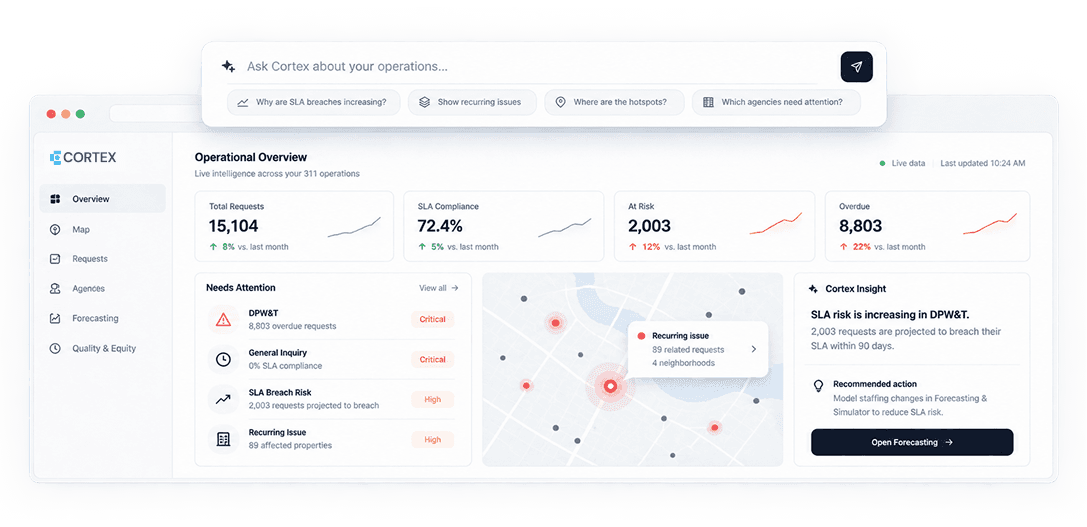
See what's happening beneath the backlog.
The gap
Cortex connects requests, operational data, and performance signals to reveal what's recurring, what's at risk, and where teams need to act.
First pass • Live illustration
Group by underlying cause
How Cortex works
Cortex connects your requests, systems, and operational data to turn fragmented signals into clear actions.
Bring requests and operational data together. Connect the systems your teams already use.
One connected view of your operations.
Cortex connects related requests and signals. Reveal duplicates, recurring issues, and patterns across your data.
See the issues behind the individual requests.
Identify risks before they become escalations. See where SLA and performance are heading.
Know what needs attention next.
Turn intelligence into clear priorities. Give teams the context they need to respond faster.
Move from insight to action.
The platform
Explore the tools that turn operational signals into faster, better-informed decisions.
One intelligence layer connecting requests, performance, forecasting, geospatial intelligence, and property-level insights.
See operational health, backlog, and SLA performance.
Predict SLA breaches and model staffing before they happen.
Find hotspots, recurring locations, and patterns hidden across the city.
Understand the full history and risk behind any address.
01 · COMMAND CENTER
Monitor SLA compliance, backlog, performance, and the issues demanding attention. Cortex brings the most important signals together so teams can act before problems escalate.
02 · FORECASTING & SIMULATOR
See potential SLA breaches before they happen. Model changes to staffing and operational capacity to understand how different decisions could affect future performance.
03 · MAP CENTER
Turn location data into operational intelligence. Identify hotspots, recurring corridors, chronic addresses, and neighborhood-level patterns that are difficult to see in spreadsheets.
04 · PROPERTY DOSSIER
Explore the history, patterns, and risks associated with a property before taking action. Cortex connects requests and issues over time to reveal what's happening at the address.
AI agents
Give residents, operators, and leaders the right intelligence for the decisions they need to make.
FAQ
A closer look at how Cortex works, connects, and helps teams make better decisions.
Cortex connects with existing platforms and data sources, creating a unified intelligence layer without requiring teams to replace their current systems.
Cortex weighs recurrence, SLA exposure, and the size of the affected population, then ranks what is heading toward a breach ahead of what is merely open. Volume alone never sets priority.
Cortex links them into one underlying issue and keeps every original request attached. Teams see a single item to act on instead of a dozen near-identical tickets, and residents still get their own updates.
Weeks, not quarters. Cortex reads the systems you already run, so the work is connecting data sources and agreeing on thresholds rather than migrating records.
Every finding carries the context needed to act on it: which department owns it, what is projected to breach, and which addresses are affected. Findings route into the queues your teams already work from.
Relationships across requests. Your 311 platform records each report accurately in isolation; Cortex reads them together to surface duplicates, chronic corridors, equity gaps, and demand trends no single record can show.
By separating true demand from noise. Once duplicates are merged and spam is filtered, the remaining backlog is small enough to rank, and Cortex ranks it by risk rather than by age.